June 11, 2026 • Kwame Osei-Bonsu • 8 min reading time • Prices verified June 18, 2026
3-in-1 Video Doorbell Smart Lock Combos: eufy E330, myQ Secure View, and the Installation Realities Nobody Warns You About
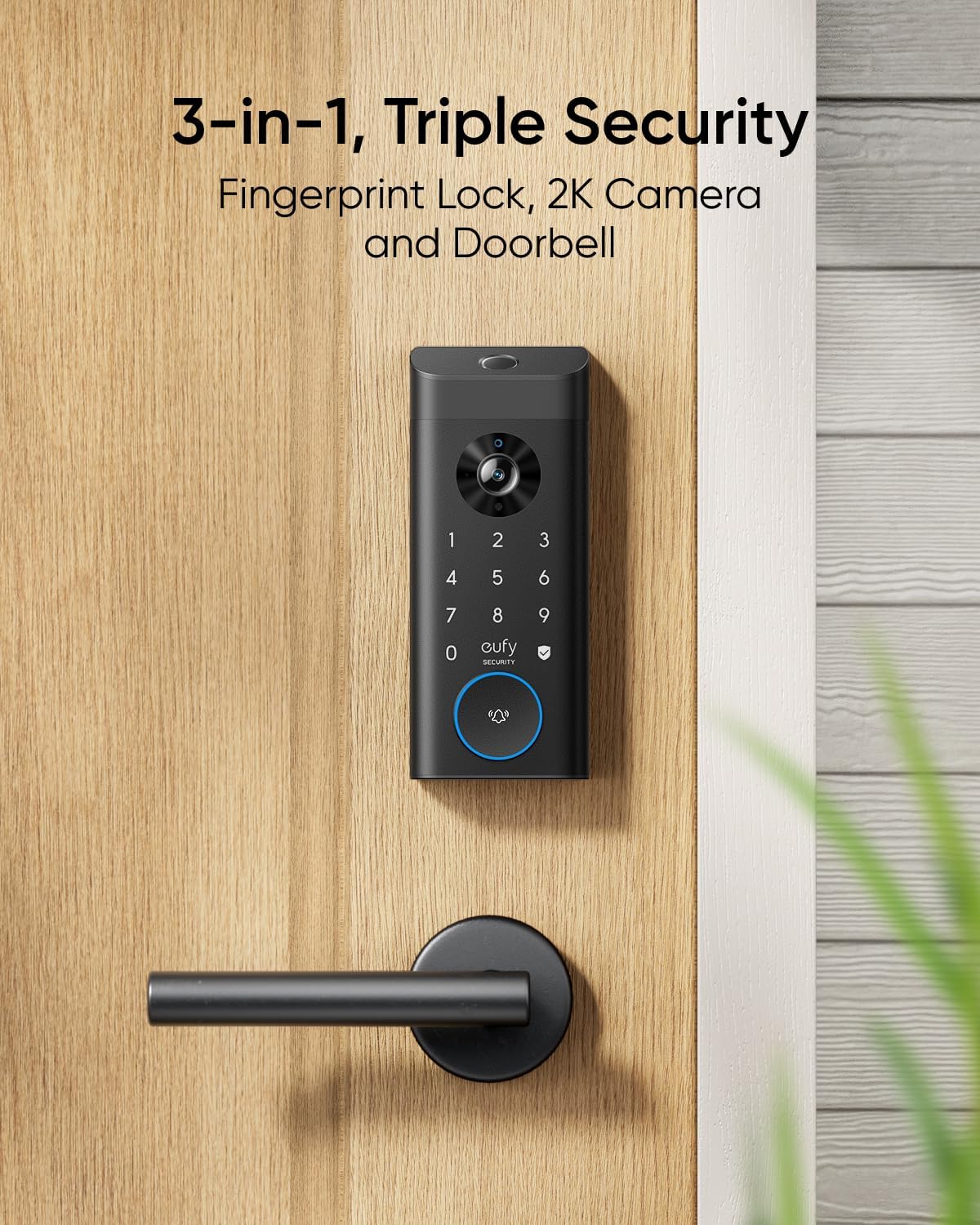
If you’ve ever wished you could answer your front door and unlock it for a guest — all from your phone, without installing two separate devices that don’t talk to each other — you’re looking at the right product category. Combo video doorbell smart locks are exactly what they sound like: a single unit that replaces both your deadbolt and your doorbell camera. You get live video of whoever’s at the door, two-way audio to talk to them, and the ability to unlock the door remotely, all managed from one app. Two devices competing for the same four inches of door frame finally merged into one. The eufy Video Smart Lock E330 and the Chamberlain myQ Secure View are the two most-discussed products in this space as of mid-2026. This article walks through how they actually differ, where each one earns its price tag, and — critically — the installation and ecosystem complications that don’t show up in the product listing.
What “3-in-1” Actually Means (and What It Doesn’t)
The marketing phrase “3-in-1” typically refers to the combination of a video doorbell (camera + microphone + speaker), a smart lock (motorized deadbolt, keypad, or fingerprint reader), and remote access (app-based unlock, live view, and alerts). The E330 hits all three cleanly. The myQ Secure View approaches it differently — it’s more accurately a video-enabled keypad that pairs with a separate smart lock mechanism, which matters a lot for your installation plan.
eufy E330: One unit replaces your existing deadbolt entirely. It includes a fingerprint reader, a PIN pad, a physical key backup, a 2K resolution camera, a built-in motion sensor, and an indoor chime. Power comes from a built-in rechargeable battery. Per PCMag’s review of the E330, the fingerprint unlock is rated fast and reliable across a range of users, and the local storage option (no cloud subscription required for basic video review) is a genuine differentiator in this category.
myQ Secure View: Chamberlain’s approach keeps the deadbolt hardware separate — you install the myQ Video Keypad alongside your existing or upgraded deadbolt rather than replacing it wholesale. This gives you more flexibility in lock hardware choice, but it means two installation footprints on your door, and the integration between keypad and lock depends on compatibility that isn’t always seamless. Tom’s Guide’s review of the myQ Video Keypad flags the setup process as notably more involved than the marketing materials suggest, particularly for doors without existing low-voltage wiring.
The honest framing: If you want one hole in your door and a genuinely integrated experience, the E330 is closer to the true combo promise. The myQ Secure View is a video doorbell with access-control features layered on — useful, but architecturally different.
Installation Realities: The Part Nobody Warns You About
This is where the category earns its reputation for buyer frustration. Both products look manageable in unboxing videos. Both products have specific conditions that turn a 45-minute install into a three-hour problem.
Door prep requirements
The E330 requires your door to have a standard 2-3/8” or 2-3/4” backset (the distance from the edge of the door to the center of the lock hole). Most US residential doors fit this. The bigger issue: the camera module sits above the lock body, which means you need adequate clearance above your existing lock hole — typically 3.5 inches of unobstructed door face. Storm doors, decorative molding, or older doors with unconventional hardware placement can all create interference. CNET’s review notes that several owners reported needing to enlarge or reposition their door strike plate to get the deadbolt throw to align correctly after installation.
The myQ Secure View’s installation complexity shifts to the wiring question. The video component benefits from — and in some configurations requires — an existing doorbell wiring circuit (16-24V AC). Older homes or apartments without existing doorbell wiring will need either a battery-powered configuration (which limits some live-view features) or an electrician for low-voltage rough-in work. That cost isn’t in the product price.
The door handedness and handing issue
Both products are sold in left-hand and right-hand configurations, and getting this wrong is a common mistake that requires a full return. “Handing” refers to which side the hinges are on when you’re facing the door from outside. Per SafeWise’s smart lock buying guidance, door handing errors account for a significant share of smart lock return requests. Measure twice, order once.
Multi-point locking and steel doors
If your front door uses a multi-point locking system (common on fiberglass and steel entry doors, ubiquitous in new construction and rental properties in hurricane-prone regions), neither device installs cleanly without a compatibility check first. Multi-point systems have three or more latch points that engage simultaneously — the standard deadbolt replacement approach used by both the E330 and myQ doesn’t map to this architecture at all. Owners on these door types will need a different product category entirely (look at Schlage Encode or Yale Assure for multi-point-compatible smart lock options).
Ecosystem Lock-In and Subscription Costs: The 3-Year View
This is where the two products diverge most meaningfully for the security-architecture buyer.
eufy E330 ecosystem: eufy uses its own HomeBase hub ecosystem and the eufy Security app. Basic local storage — recorded clips saved to the lock’s internal memory — functions without any subscription. Per CNET’s analysis, the E330 stores up to 30 days of local event clips onboard, which is a meaningful privacy and cost advantage. Cloud backup and extended storage require eufy’s Security Plan, which runs approximately $3/month per device or $10/month for a household plan as of early 2026.
The lock integrates with Amazon Alexa and Google Home for voice commands, and has HomeKit compatibility through eufy’s HomeBase — though reviewers at PCMag note the HomeKit integration has historically had latency quirks worth knowing about before you build a HomeKit-dependent automation around it.
myQ Secure View ecosystem: Chamberlain’s myQ platform has a more complicated subscription history. The professional monitoring integration with Apple Home Key support and third-party integrations has shifted behind a myQ premium tier in recent years. Tom’s Guide’s review specifically flags that remote access features which were once free have migrated to paid tiers — a pattern that matters if you’re evaluating 5-year total cost of ownership.
By the numbers — estimated 3-year cost:
| Scenario | Hardware | Subscription (3 yr) | 3-Year Total |
|---|---|---|---|
| eufy E330, local storage only | ~$200 | $0 | ~$200 |
| eufy E330, cloud plan | ~$200 | ~$108 | ~$308 |
| myQ Secure View + lock hardware | ~$180–$280 | ~$120–$180 | ~$300–$460 |
Estimates based on published retail pricing as of Q1 2026 and publicly listed subscription tiers. Pricing changes; verify before purchasing.
Privacy Trade-Offs and What to Do About Them
Anything with a camera pointed at your front door is worth thinking about carefully. Both devices collect video and biometric data (fingerprints, in the E330’s case). Here’s what’s known and what’s worth mitigating.
eufy and cloud privacy: eufy (an Anker Innovations brand) received significant critical attention in 2022–2023 over claims that some footage was accessible via cloud URLs without authentication. The company subsequently overhauled its privacy architecture and added end-to-end encryption for cloud clips. Per Security.org’s 2025 home security research overview, consumer confidence in eufy’s cloud security has partially recovered, but the incident is worth knowing about. If this history concerns you, the E330’s local-only storage mode is a legitimate mitigation — clips stay on the device and never touch eufy’s servers unless you opt into cloud backup.
Fingerprint data: The E330 stores fingerprint templates locally on the device, not in the cloud. This is meaningfully better than systems that send biometric data to a remote server, but it means your fingerprint template is on a physical device that can be stolen. Physical theft of the entire lock unit is a low-probability scenario, but not zero.
Concrete steps: Enable end-to-end encryption if using cloud backup. Set your motion detection zones to avoid capturing public sidewalk footage unnecessarily (reduces data volume and potential legal exposure for landlords). Review app permissions and disable microphone access when not actively using two-way talk.
Who Should Buy Which Product
If your situation maps cleanly to one of these, the decision gets easier:
Choose the eufy E330 if:
- You want a true single-unit replacement for your deadbolt + doorbell setup
- Local storage without a subscription is important to you (it should be)
- You’re in a standard residential door configuration with no storm door and no multi-point lock
- You manage 1–3 doors and want a self-contained system that doesn’t depend on cloud uptime
Choose myQ Secure View if:
- You already have myQ garage door hardware and want a unified Chamberlain ecosystem across your entry points
- You prefer keeping your existing deadbolt (or upgrading to a specific lock model independently)
- You’re comfortable with the subscription model and have evaluated the 3-year cost
- You need video-doorbell features more than integrated lock control — the camera hardware in the myQ Secure View earns positive marks from reviewers focused on video quality
If neither fits: For rental properties with high-traffic access needs, or any door with a multi-point locking system, look at dedicated smart lock platforms (Schlage Encode Plus, Yale Assure Lock 2) paired with a separate video doorbell (Ring Video Doorbell Pro 2, Arlo Essential Video Doorbell) and connect them through a shared smart home hub. The integration is less seamless, but the individual components are better at their primary jobs, and you’re not locked into a single vendor’s ecosystem.
The combo category is genuinely appealing — one app, one device, one installation footprint. The E330 is the stronger expression of that promise in mid-2026. But the installation variables and ecosystem considerations above are real constraints, not fine print. Know your door before you order.