May 17, 2026 • Kwame Osei-Bonsu • 10 min reading time • Prices verified June 18, 2026
Smart Lock Compatibility Before You Buy: Matching Deadbolts, Backsets, and Door Thickness to Prevent Returns
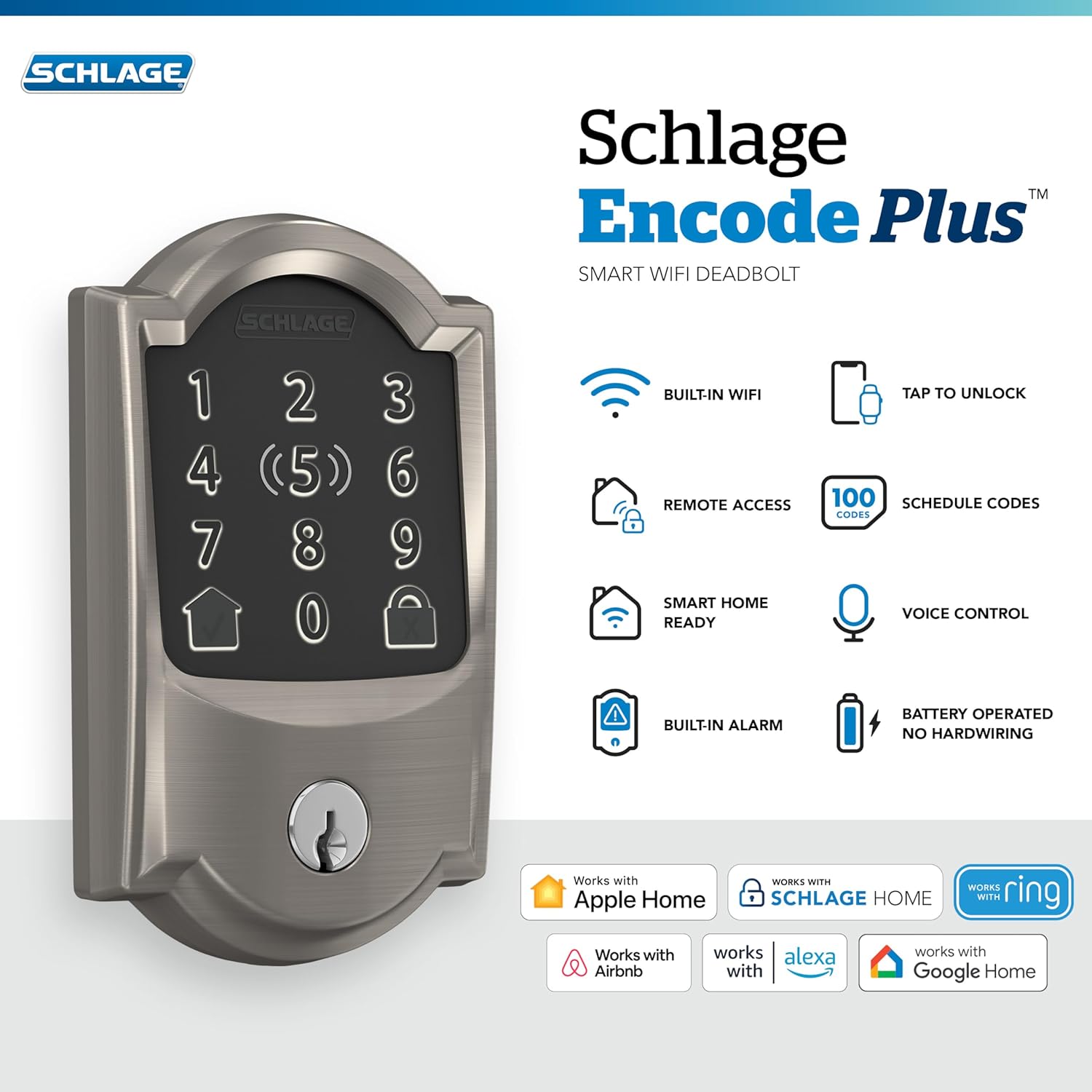
A smart lock is an electronic deadbolt — the bolt mechanism on your front door that keeps it locked — with a keypad, app, or voice-assistant connection layered on top. The appeal is obvious: no more hiding a spare key under the mat, remote-unlock for your dog walker, and an activity log that tells you exactly when your teenager got home. But the most frustrating thing that happens to first-time smart lock buyers is ordering a sleek new Schlage Encode or Yale Assure, opening the box with genuine excitement, and discovering the lock physically will not fit their door. The return rate on smart locks driven by dimension mismatches is meaningfully higher than most other home hardware categories — and every one of those returns is preventable with about ten minutes and a tape measure. This guide gives you the exact measurements to take, explains what they mean, and maps them to specific lock models so you can buy with confidence.
| EDITOR'S PICK[Schlage Encode Smart Wi-Fi Dead…](https://www.amazon.com/dp/B07HXFKMYR?tag=greenflower20-20) | Mid-tier[Aqara Smart Lock U100](https://www.amazon.com/dp/B0BZSD2L1W?tag=greenflower20-20) | Budget pick[eufy Security Smart Lock C210](https://www.amazon.com/dp/B0BCV3NBKY?tag=greenflower20-20) | |
|---|---|---|---|
| Fingerprint | ✗ | ✓ | ✗ |
| Apple Home Key | — | ✓ | — |
| Weatherproof | — | IP65 | — |
| Price | $229.00 | $149.99 | $89.99 |
| See on Amazon → | See on Amazon → | See on Amazon → |
The Three Numbers That Determine Fit: Backset, Cross-Bore, and Door Thickness
Before you look at a single product listing, you need three measurements from your existing door hardware. Take them with a steel tape measure, not a fabric one.
Backset is the distance from the edge of the door (the narrow side you’d see when the door is open) to the center of the large round hole where your current lock cylinder sits. Almost every residential door in North America has one of two backsets: 2-3/8 inches or 2-3/4 inches. The difference matters because the lock’s latch mechanism — the small spring-loaded bolt — is manufactured to match one or the other. Most smart locks ship with adjustable latches that accommodate both, but not all do. Schlage’s published documentation confirms that the Encode Plus ships with a dual-position latch; Yale’s installation manual for the Assure Lock 2 specifies the same. Confirm this in the spec sheet before you buy; do not assume.
Cross-bore diameter is the size of that large round hole in the door face. The industry standard for residential doors in the US is 2-1/8 inches (also called a 2-1/8” prep). Nearly every smart lock on the market is designed for this diameter. Where things get complicated is older doors (pre-1970s construction is common in urban rental portfolios) and some imported steel doors that were prepped with a 1-1/2” or non-standard bore. If your door has a non-standard bore, you either need a lock explicitly rated for it or a licensed carpenter to re-bore — a $75–$150 job that’s worth factoring into your decision.
Door thickness is where the most overlooked mismatches occur. Standard residential doors are 1-3/8 inches thick (common in interior applications) or 1-3/4 inches thick (standard exterior doors). Many smart locks list a thickness range, but that range sometimes excludes the storm doors, security doors, and reinforced hollow-metal doors that renters and landlords increasingly install. The New York Times Wirecutter’s 2025 smart lock review explicitly flags door thickness as one of the top reasons for incompatible installs, noting that some keypad-style locks bottom out on thicker doors before the exterior and interior assemblies can clamp together properly.
By the numbers:
- Standard backsets: 2-3/8” or 2-3/4” (measure; don’t guess)
- Standard cross-bore: 2-1/8” diameter
- Standard exterior door thickness: 1-3/4” (range most smart locks support: 1-3/8” to 2”)
- Reinforced / security door thickness: up to 2-1/4” — verify lock max before ordering
Deadbolt Type: Single Cylinder, Double Cylinder, and Why It Matters for Retrofit
Smart locks do not replace your entire door hardware set — they retrofit onto an existing deadbolt prep. But what type of deadbolt you currently have shapes which smart locks you can install without additional work.
A single-cylinder deadbolt is the standard: you turn a thumbturn on the inside and use a key on the outside. This is what 95% of residential smart locks are designed to replace. Installation is a direct swap — remove the old deadbolt, install the smart lock, done.
A double-cylinder deadbolt requires a key on both sides. These are installed on doors with glass panels (so an intruder can’t break the glass and reach a thumbturn) or in some commercial applications. Smart locks almost universally cannot replace a double-cylinder deadbolt without modifying the door, because their interior assemblies are thumbturn-based or motor-driven and have no mechanism for a key on the inside. If you’re managing a rental with double-cylinder deadbolts on doors with sidelights or glass panels, you have three options: re-prep the door for a single-cylinder application, consult a licensed locksmith about a glass-break sensor plus single-cylinder upgrade, or accept that a smart lock is not the right solution for that specific door.
Grade ratings are worth a brief mention here. Deadbolts are graded by ANSI/BHMA (the American National Standards Institute / Builders Hardware Manufacturers Association) on a three-tier scale: Grade 1 (commercial, highest security), Grade 2 (residential heavy-duty), Grade 3 (residential basic). Per SafeWise’s smart lock buying guide, the Schlage Encode holds a Grade 1 rating — the same as commercial hardware. The Yale Assure Lock 2 carries a Grade 2 rating. For most residential applications, Grade 2 is sufficient; for a short-term rental where the lock faces high cycle volume and potentially rough handling, Grade 1 is worth the price premium. Consumer Reports’ smart lock ratings consistently show Grade 1 locks outperforming Grade 2 equivalents in cycle-life testing, with meaningful gaps appearing after 100,000+ operation cycles.
Door Edge Prep: The Faceplate and Latch Compatibility You’re Probably Ignoring
Here’s the measurement most buyers skip entirely: the door edge prep, which is the mortise cutout on the narrow edge of the door where the latch assembly sits. There are two common configurations.
A full lip or standard faceplate prep has a rectangular cutout sized for a standard ANSI faceplate, typically 1” × 2-1/4”. This is the prep most North American doors ship with, and nearly every residential smart lock matches it.
A round corner or radius corner faceplate has rounded edges on the rectangular cutout. Some door manufacturers use this style, and if your door has a radius-corner prep, a flat-cornered latch faceplate will sit proud of the door edge — not flush — which affects both appearance and latch engagement. Schlage’s door hardware compatibility documentation specifically calls out this distinction and notes that some of their latch assemblies include both a standard and radius-corner faceplate in the box. Verify this in the product listing, because not every brand does.
The second edge-prep issue is the strike plate — the metal plate mortised into the door frame where the bolt seats. Smart locks don’t change the strike plate, but if your current strike plate is loose, misaligned, or installed in a door frame with soft wood, upgrading to a three-inch reinforced strike plate (roughly $12–$20 at any hardware store) before installing a smart lock is cheap insurance. PCMag’s smart lock buying guide, in its 2025 update, explicitly recommends this step, noting that a Grade 1 lock mounted on a Grade 3 strike plate effectively inherits the weaker security rating of the hardware chain’s weakest link.
Ecosystem Fit: Matching the Lock to Your Existing Hub or App
Physical fit is necessary but not sufficient. The second compatibility layer is the smart home protocol — the wireless language your lock uses to communicate with other devices or a central hub.
As of mid-2026, the dominant protocols for residential smart locks are:
- Z-Wave — the incumbent in dedicated security systems; used by Schlage Encode Plus (Z-Wave version), SmartThings, and most professional monitoring platforms. Low-power mesh network, strong range in residential settings.
- Zigbee — used by some Yale models; also mesh, slightly higher data throughput but shorter individual node range than Z-Wave.
- Wi-Fi direct — used by Schlage Encode (non-Plus), Wyze Lock, and others. Connects directly to your router without a hub, which is simple but creates a persistent connection that draws more battery power and surfaces the lock as a direct internet-facing device. The New York Times Wirecutter’s current smart lock review notes that Wi-Fi direct locks typically run through batteries 2–3× faster than Z-Wave or Zigbee equivalents under similar use patterns.
- Matter over Thread — the emerging standard backed by Apple, Google, Samsung, and Amazon. Yale Assure Lock 2 and Schlage Encode Plus are both Matter-certified as of their 2024–2025 firmware updates. If you’re building a new smart home ecosystem today, Matter-compatible locks are the most future-resistant choice because they’re designed to avoid single-ecosystem lock-in.
If you already have a Ring Alarm Pro or SimpliSafe hub, verify protocol compatibility before ordering. Ring Alarm uses Z-Wave for third-party locks; SimpliSafe does not natively support third-party locks at all as of May 2026, which means pairing a Yale or Schlage directly into a SimpliSafe ecosystem requires a parallel hub like SmartThings or a Matter bridge — added complexity and cost worth modeling into your total installation budget.
Decision Framework: If X, Then Y
After reviewing the specs, installation documentation, and aggregated owner reports across the major review platforms, here’s the decision logic that applies to most residential situations:
If your door is standard 1-3/4” thick, has a 2-1/8” cross-bore, and you want Grade 1 security with Matter compatibility: the Schlage Encode Plus is the practitioner default. Owners in long-run reviews consistently note reliable app connectivity and strong build quality; the Grade 1 ANSI rating and Matter support give it the best combination of physical security and ecosystem longevity in the consumer segment.
If you need Zigbee or have a SmartThings-centric ecosystem: the Yale Assure Lock 2 is the natural fit. The keypad-only form factor (no key cylinder) is divisible — landlords appreciate that there are no keys to track — and Yale’s published specs confirm compatibility with SmartThings, Amazon Alexa, and Google Home natively.
If you’re managing a short-term rental and need remote access without a hub: a Wi-Fi direct lock like the Schlage Encode (non-Plus) keeps the install simple, but build in a battery replacement cadence — owners consistently report replacing batteries every 3–4 months under high-use conditions versus 9–12 months for Z-Wave equivalents. Over three years at a property, that delta is worth calculating before you commit.
If your door is thicker than 2 inches or has a non-standard bore: stop before ordering any retail lock. The correct move is a site visit from a licensed locksmith to document exact dimensions, followed by a targeted product search using those measurements. Forcing a wrong-fit lock onto an oversized door risks both security and door integrity.
If you have double-cylinder deadbolts throughout: a smart lock upgrade requires either a door modification consultation or a rethink of the security architecture entirely — a keypad lock on the interior combined with a standard keyed deadbolt on the exterior is one pattern landlords use on glass-panel doors, though this introduces its own tradeoffs in automation and access management.
The ten minutes you spend with a tape measure before you order is the only thing standing between you and a box you’re shipping back. Measure twice, match the protocol to your hub, and check the grade rating against your use case. The lock that fits correctly and talks to your existing ecosystem on day one is worth far more than the one with the most impressive spec sheet sitting in your return queue.