May 22, 2026 • Kwame Osei-Bonsu • 9 min reading time • Prices verified June 18, 2026
Motion-Activated Security Lighting That Actually Deters: Hardwired vs. Solar vs. Battery for Every Budget
Motion-activated security lighting sounds simple: something moves, the light turns on, would-be intruders think twice. But once you start comparing products, you hit a wall of lumens ratings (lumens measure brightness — one lumen roughly equals the light from a single birthday candle), PIR sensor specs (PIR stands for passive infrared, the technology that detects body heat and movement), IP weather ratings, and power-source debates. If you’ve got a camera system already running, lighting is the force multiplier that makes those cameras actually useful at night. If you’re starting from scratch, the power source you choose now — hardwired, solar, or battery — locks in your maintenance burden and reliability ceiling for years. This guide cuts through the noise: here’s what the research and owner reports actually support, what the three power categories genuinely cost over time, and a clear decision framework at the end.
Why Power Source Is the Most Consequential Decision You’ll Make
Before you compare brands or lumen counts, you need to land on how the light gets its power. Every other variable — placement flexibility, reliability in bad weather, long-term cost — flows downstream from that choice.
Hardwired: The Reliability Baseline
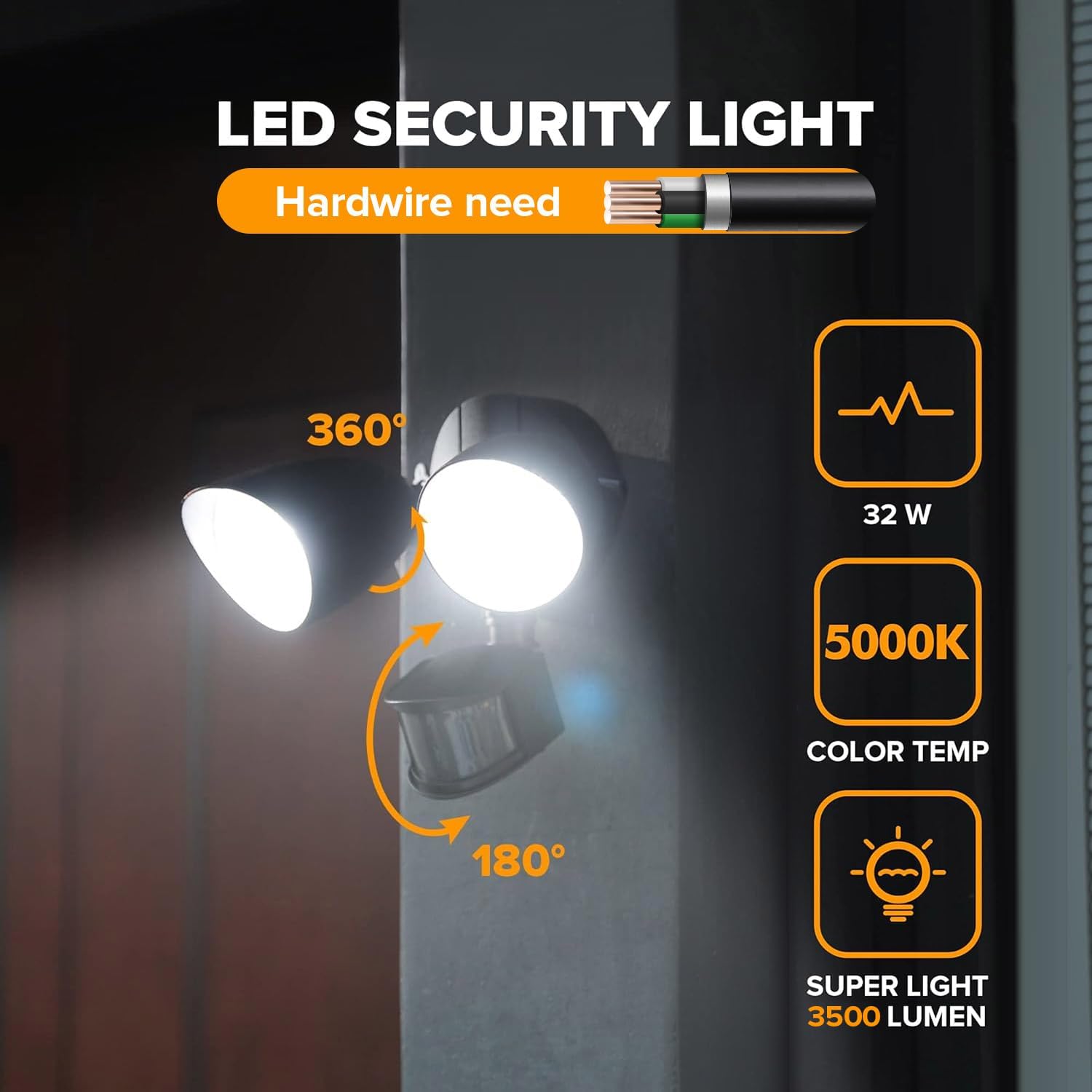
Hardwired lights tap into your home’s AC electrical system, typically at an existing junction box or via a new circuit run by an electrician. The core advantage is zero maintenance after installation: no batteries to swap, no solar panels to clean, no wondering whether the light will fire after three overcast days. Owners consistently report hardwired fixtures as the most reliable performers over multi-year deployments.
The tradeoff is installation friction. If you don’t have an outdoor junction box where you want the light, you’re looking at either a DIY wire run (viable for intermediate electricians comfortable with outdoor-rated conduit) or a $150–$350 electrician call per fixture location. For locations where a junction box already exists, hardwired is almost always the lowest total-cost, highest-reliability option — the math is hard to beat.
 product image](/images/external/3d395f4b2296.jpg)
MIHANI
$20.99
In stock on Amazon
Check price on AmazonSolar: Flexible but Weather-Dependent
Solar lights harvest energy during the day and store it in an onboard lithium battery. The pitch is obvious — no wiring, no electricity cost, install anywhere with sun exposure. The real-world limitation that aggregated owner reviews keep surfacing, as documented in CNET’s review titled “Best Outdoor Motion Sensor Lights for 2025,” is that solar lights underperform in winter at latitudes above roughly 40°N, on north-facing walls, and during extended overcast stretches.
For a garage corner with four hours of direct sun daily, solar is genuinely capable. For a shaded side-yard access point you actually need secured, it’s a gamble. The honest diagnostic: before you spec solar for any location, observe that spot at solar noon (roughly 12–1 PM local time) in the current season. If there’s meaningful shade on the panel location, solar is not your answer for that spot.
Mid-tier solar floodlights have improved meaningfully since 2022 — better panel efficiency, larger onboard batteries (often 5,000–8,000 mAh), and smarter standby modes to extend reserve life. Owners in warmer, sunnier climates consistently report reliable performance. Owners in Great Plains, Great Lakes, and New England climates report significantly more variability, especially October through March.
The 2026 market has also produced a hybrid category: solar-primary with optional USB-C or AC backup charging. For installations where solar is the preferred option but reliability cannot be compromised, these hybrids are worth the premium — they give you solar economics on most days and hardwired-level confidence on the rest.
 product image](/images/external/a85c706cbbdf.jpg)
LEPOWER
$35.98
In stock on Amazon
Check price on AmazonBattery-Operated: Flexibility Without Sun Dependency
Battery-operated lights (usually AA lithium or a rechargeable internal pack) offer the same placement flexibility as solar without the weather dependency — but they introduce a maintenance loop. Published manufacturer cycles for motion-activated LED fixtures suggest 6–18 months per charge or battery set under moderate use. That’s manageable for one fixture; it becomes a tracking problem across a multi-unit property.
For installations where solar isn’t viable and running wire isn’t practical, battery-operated with a rechargeable internal pack (not AA) is the most sensible fallback. Budget a recharge cycle into your quarterly property walkthrough routine and the maintenance burden stays contained.
 product image](/images/external/7b7016a6c04c.jpg)
Lutron
$39.98
In stock on Amazon
Check price on AmazonThe Real Numbers: 3-Year Total Cost of Ownership
Here’s a comparison across typical options in each category, based on published pricing as of mid-2026 and owner-reported maintenance patterns:
| Power Type | Avg. Purchase Price | 3-Year Add’l Cost | 3-Year Total |
|---|---|---|---|
| Hardwired (DIY-ready junction box) | $45–$90 | ~$8 electricity | $53–$98 |
| Hardwired (requires electrician) | $45–$90 + $200 install | ~$8 electricity | $253–$298 |
| Solar (quality mid-tier) | $35–$75 | $0–$15 (cleaning, occasional battery) | $35–$90 |
| Battery (rechargeable internal) | $30–$65 | $0 direct, ~6–8 hrs/yr charging time | $30–$65 |
| Battery (AA lithium replacements) | $25–$50 | $20–$45 in batteries | $45–$95 |
| Combo floodlight-camera (cloud sub) | $150–$250 + sub | $108–$360 subscription | $258–$610 |
MIHANI
$20.99
In stock on Amazon
Check price on AmazonLEPOWER
$35.98
In stock on Amazon
Check price on AmazonLutron
$39.98
In stock on Amazon
Check price on AmazonThe headline insight: if you already have a usable outdoor junction box, hardwired is almost always the lowest total-cost, highest-reliability option over three years. The math only flips when you need to pay for electrical work — at which point solar or battery becomes attractive for locations where those technologies are adequate.
What Brightness and Sensor Placement Actually Do for Deterrence
Lumens matter, but not infinitely. Research on lighting as a crime deterrent is more nuanced than the marketing copy suggests. The U.S. Department of Justice, Office of Justice Programs, in its situational crime prevention research summary, documents that lighting deters when it increases the perceived risk of detection — meaning a potential intruder believes they’ll be seen. That requires both adequate brightness and appropriate placement relative to entry points and sight lines from the street or neighbors.
The practical implication: a 2,500-lumen fixture aimed correctly at a door beats a 5,000-lumen fixture aimed at a tree. Wirecutter’s buying guide titled “The Best Motion-Sensor Security Lights” (published by Wirecutter, a New York Times company) consistently recommends a minimum of 700 lumens for pathway illumination and 1,500–2,500 lumens for perimeter and driveway coverage — beyond which returns diminish unless you’re covering a very wide area.
Sensor range and zone shape matter just as much as brightness. Most mid-tier fixtures advertise 180-degree detection at 30–70 feet. Owners report that real-world detection often runs 20–30% shorter than the rated range in cold weather, because PIR sensors rely on thermal contrast between a moving body and the ambient environment — contrast that shifts at temperature extremes. SafeWise’s annual report titled “2025 Home Security Statistics and Research” notes that most residential break-in attempts occur at front and back doors and first-floor windows, so sensor placement should prioritize those vectors rather than simply covering the widest possible area.
Ecosystem Integration and the Subscription Cost Problem
Standalone vs. Combo Units
Several mid-to-upper-tier fixtures now combine a PIR floodlight with a camera. For a camera-first security architecture, these make obvious sense — one device, one mounting hole, unified app. The tradeoff documented in PCMag’s roundup titled “The Best Smart Security Lights” is that combo units are almost always subscription-dependent for cloud clip storage, adding $3–$10 per month per device. Over 36 months, that’s $108–$360 per fixture in subscription costs stacked on top of hardware.
Local-storage NVR users building a Hikvision or Lorex ecosystem will typically do better separating their cameras from their lighting — a dedicated hardwired floodlight plus a PoE IP camera gives more control and no subscription dependency.
MIHANI
$20.99
In stock on Amazon
Check price on AmazonSmart Ecosystem Integration: Shallower Than Advertised
Standalone motion-sensor lights are a complete solution for basic deterrence. But if you’re already running a Ring Alarm, SimpliSafe, or Google Nest ecosystem, smart lights start earning their keep through coordination — a motion trigger on a camera wakes a light, a light trigger logs to your security dashboard, a perimeter breach activates multiple zones simultaneously.
The caveat that PCMag’s roundup titled “The Best Smart Security Lights” flags consistently: ecosystem integration is often shallower than advertised. Ring’s motion zones and floodlight triggers work reliably within the Ring ecosystem; they don’t talk natively to SimpliSafe. Arlo lights coordinate with Arlo cameras natively but integration with third-party systems typically requires IFTTT or Home Assistant workarounds that add fragility. Buyers building a mixed ecosystem should verify specific integration depth before purchasing — not assume Z-Wave or Zigbee compatibility means seamless operation.
For landlords managing multiple properties, the most operationally durable setup noted in both SafeWise’s annual report titled “2025 Home Security Statistics and Research” and Wirecutter’s buying guide titled “The Best Motion-Sensor Security Lights” for multi-unit contexts is hardwired fixtures on dedicated circuits paired with a smart switch at the breaker level. That gives remote control and scheduling without device-level app dependency, and it works regardless of whether individual fixture firmware gets updated or a brand changes ownership.
LEPOWER
$35.98
In stock on Amazon
Check price on AmazonBuilding a Camera-Integrated System Without Subscription Lock-In
If you want floodlight-plus-camera capability without recurring cloud fees, the practical path documented in CNET’s review titled “Best Outdoor Motion Sensor Lights for 2025” is to pair a dedicated hardwired floodlight with a local-storage PoE camera rather than buying a combo unit. You lose the single-bracket convenience but gain full ownership of your footage, no monthly billing, and the ability to upgrade either component independently. For most intermediate security builders, that tradeoff is worth taking.
Lutron
$39.98
In stock on Amazon
Check price on AmazonThe Decision Framework: Matching Power Source to Installation Reality
You’re at decision point. Here’s the honest routing logic based on your situation:
If you have an existing outdoor junction box at the target location: Install a hardwired fixture. Highest reliability, lowest 3-year cost, no maintenance after installation. Budget picks in the $30–$60 range from established brands cover most residential applications. Step-up picks in the $65–$120 range deliver better sensor range and heavier-gauge housings rated for harsh climates.
If you need placement flexibility and your location gets five or more hours of direct sun daily: Solar is viable. Prioritize panel size (10W rated or better), battery capacity (6,000 mAh or better), and an IP65 or higher weather rating. Consider a hybrid solar-plus-USB-C unit if reliable winter performance matters to your security plan.
If you need placement flexibility and solar isn’t reliable at your location: Battery-operated with a rechargeable internal pack rather than disposable AA cells. Build a recharge check into your quarterly property walkthrough and the maintenance burden stays manageable.
If you’re building a camera-integrated smart home ecosystem: Evaluate a combo floodlight-camera unit — but run the subscription math first. At $10 per month per device over three years, a $200 combo unit costs $560 all-in. That changes the calculus compared to a $60 hardwired floodlight paired with a $130 PoE camera on local storage.
If you’re a landlord standardizing across multiple units: Hardwired, hardwired, hardwired. The maintenance-free profile is worth the upfront electrical investment at scale. One service call to wire four junction boxes saves dozens of battery-swap or solar-troubleshooting visits over a five-year horizon.
The bottom line on deterrence value: the U.S. Department of Justice, Office of Justice Programs, situational crime prevention research summary is consistent that visible, well-placed lighting reduces opportunistic crime by increasing perceived detection risk. The best light is the one that reliably turns on every time — which means matching the power source to the installation reality, not to the marketing pitch. A $40 hardwired fixture in the right spot outperforms a $120 solar unit that goes dark every November. Get the power source right first, then optimize for lumens, sensor range, and ecosystem fit.